
Lead generation marketing has changed more in the last 18 months than in the decade before it. Buyers now ask ChatGPT, Gemini and Google’s AI Overviews for recommendations before they ever click a link. Third-party cookies are fading, cold email filters are stricter, and B2B buying committees consume a dozen pieces of content before they talk to sales.
Yet many teams still run the same playbook: a gated eBook, a generic newsletter, and a few paid ads. The result? Plenty of form fills, very few sales-ready leads.
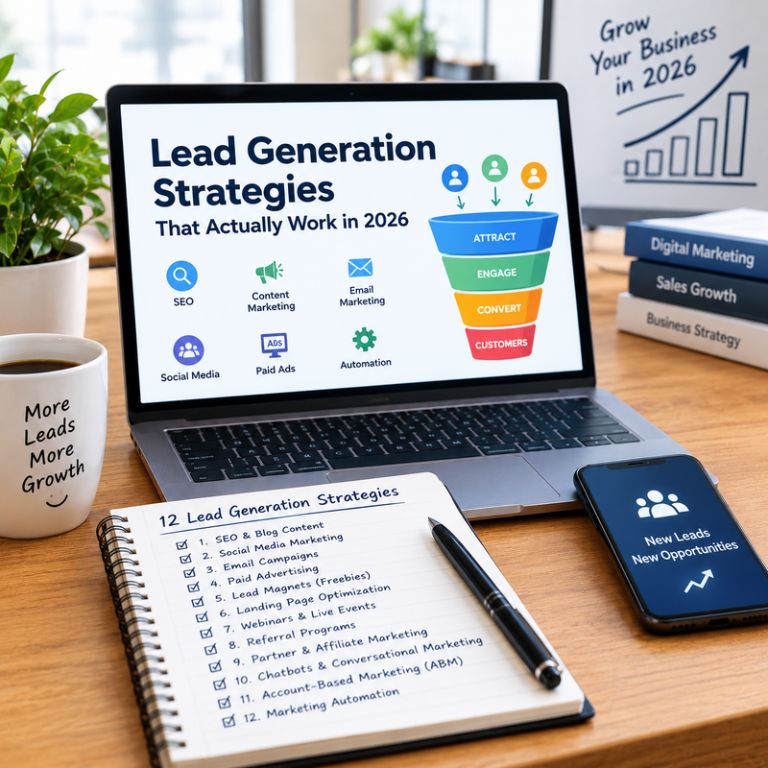
This guide breaks down 12 lead generation strategies that are working right now, with practical lead generation tips for each, benchmark data, and a clear answer to two questions we hear constantly: how to do lead generation in digital marketing, and how to do B2B content marketing to generate leads.
What Is Lead Generation Marketing?
Lead generation marketing is the process of attracting potential customers, capturing their contact details, and nurturing them until they are ready to buy. A “lead” is anyone who has shown interest a demo request, a webinar sign-up, a downloaded checklist, or a reply to an outreach email.
Good marketing lead generation is not about volume. It is about a qualified pipeline: the right people, at the right stage, with a clear next step.
Lead Generation Benchmarks: Which Channels Convert Best?
Before choosing lead generation strategies, look at how leads from each channel actually convert. Referral and high-intent channels lead, while SEO beats most paid options on lead quality.
Lead-to-MQL Conversion Rate by Channel
| Channel | Lead-to-MQL Conversion Rate |
| Client referrals | 56% |
| Executive events | 54% |
| SEO | 41% |
| Email marketing | 38% |
| PPC | 29% |
| Webinars | 19% |
Source: FirstPageSage 2025 report, as cited by Snov.io (2026).
Average Cost Per Lead by Paid Platform
| Platform | Average CPL (USD) |
| Facebook lead ads | $27.66 |
| Google Ads | $70.11 |
| Blended average (paid + organic, all industries) | $391.80 |
Source: Snov.io Lead Generation Statistics 2026.
Why Leads Fail
| Metric | Value |
| Marketing leads that never convert due to poor nurturing | 79% |
| More sales-ready leads from companies that excel at nurturing | +50% |
| Lower cost per lead for strong nurturers | 33% lower |
Sources: Salesforce and Forrester Research, as cited by G2 Learn Hub.
12 Lead Generation Strategies That Actually Work
1. Optimise for AI Search and Generative Engines (GEO)
Buyers increasingly start research inside AI assistants. If your brand is not cited in AI Overviews or ChatGPT answers, you lose leads you never knew existed.
Lead generation tips:
- Answer specific buyer questions in clear, quotable paragraphs of 40–60 words.
- Add FAQ, HowTo and Organization schema.
- Publish original data AI engines prefer citing primary sources.
- Track brand mentions in AI answers monthly.
2. Build High-Intent SEO Content (Bottom of Funnel First)
SEO-driven leads convert at far higher rates than outbound leads. But most blogs target only top-of-funnel terms. Start with “best [service] for [industry]”, “[tool] vs [tool]”, pricing and alternatives pages the searches people make right before they buy.
3. Use B2B Content Marketing That Sales Can Actually Use
If you’re wondering how to do B2B content marketing to generate leads, start with sales conversations. Ask your sales team the top 10 objections they hear, then create one asset per objection: a case study, a comparison guide, an ROI calculator, or a short explainer video.
B2B content framework:
- Awareness: problem-focused blog posts and LinkedIn carousels.
- Consideration: comparison guides, webinars, benchmark reports.
- Decision: case studies, pricing pages, ROI calculators, demos.
4. Replace Static Lead Magnets With Interactive Tools
Interactive content converts at roughly twice the rate of static PDFs. Quizzes, graders, audits and calculators give an instant result in exchange for an email. At Marketing Flavour, a free SEO audit tool is a strong example: users get value instantly, and you get a qualified lead with real website data.
5. Make LinkedIn Your B2B Lead Engine
LinkedIn remains the dominant B2B social platform for lead generation. Founder-led content, employee advocacy and native document posts outperform company-page links.
Lead generation tips for LinkedIn:
- Post 3–4 times weekly from a real person’s profile.
- Use carousels and native PDFs rather than external links.
- Run Lead Gen Forms they pre-fill details and cut friction.
- Retarget engaged viewers with a webinar or case study.
6. Run Webinars and Live Events With a Clear Follow-Up
Webinars attract many registrants but convert fewer to MQL unless the follow-up is strong. Send the replay within 24 hours, offer a short consultation, and segment attendees from no-shows.
7. Turn Email Into a Nurturing System, Not a Broadcast
Since most leads fail at nurturing, email is where marketing lead generation is won or lost.
- Build a 5–7 email welcome sequence for every lead magnet.
- Segment by industry, role, and content consumed.
- Use behaviour triggers: pricing page visit → case study email.
- Keep cold outreach personalised and short; avoid tracking pixels that hurt deliverability.
8. Launch Paid Ads With Tight Targeting and Strong Offers
Paid search and social bring speed. The mistake is sending ad traffic to a homepage. Build one landing page per offer, match the ad message, and test offers (free audit vs. template vs. demo) before scaling budget.
9. Optimise Landing Pages for Conversion
Small changes often double conversions:
- One goal per page; remove main navigation.
- Short forms (name, email, company) for top-funnel offers.
- Social proof above the fold: logos, ratings, a one-line testimonial from a real client.
- Fast load times on mobile.
10. Build a Referral and Partner Program
Referrals convert better than any other channel in the benchmark above. Formalise it: give clients a simple referral link, offer a reward, and partner with complementary agencies or tools for co-marketing webinars and content swaps.
11. Use Chatbots and Conversational Marketing
AI chat on high-intent pages (pricing, services, contact) captures visitors who will not fill a form. Configure it to qualify leads with 2–3 questions and book meetings directly into your calendar.
12. Score, Route and Measure Every Lead
Lead scoring connects marketing to revenue. Assign points for fit (industry, company size, role) and intent (pricing views, demo requests). Route hot leads to sales within an hour, and measure cost per SQL not just cost per lead.
How to Do Lead Generation in Digital Marketing: A 5-Step Plan
If you’re starting from scratch, here’s how to do lead generation in digital marketing step by step:
- Define your ideal customer profile (ICP) – industry, size, role, pain points.
- Pick two channels – that match where your ICP spends time (e.g., SEO + LinkedIn for B2B).
- Create one strong offer – per funnel stage.
- Build the nurture path – email sequence, retargeting, sales follow-up.
- Measure and iterate monthly – conversion rate, cost per SQL, and pipeline value.
Common Lead Generation Mistakes to Avoid
- Chasing lead volume instead of lead quality.
- Gating every piece of content.
- No follow-up within 24 hours.
- Marketing and sales using different definitions of a “qualified lead”.
- Ignoring AI search visibility.
Need Help With Lead Generation Marketing?
Marketing Flavour builds full-funnel lead generation marketing programs SEO, GEO, paid ads, content and email automation tied to pipeline, not vanity metrics. Talk to our team or try our free SEO audit to see where your leads are leaking.
FAQs About Lead Generation Marketing
What is lead generation marketing?
Lead generation marketing is the process of attracting potential customers and capturing their contact information through content, ads, SEO, email, social media and events, then nurturing them until they are ready to buy.
What are the best lead generation strategies in 2026?
The most effective lead generation strategies in 2026 are AI search optimisation (GEO), bottom-of-funnel SEO content, LinkedIn thought leadership, interactive lead magnets, referral programs, and automated email nurturing.
What are some quick lead generation tips for small businesses?
Start with a Google Business Profile, one high-value free offer (an audit or checklist), a short-form landing page, and a 5-email follow-up sequence. Ask every happy client for a referral.
How does marketing lead generation differ from sales lead generation?
Marketing lead generation attracts and nurtures prospects at scale through content and campaigns. Sales lead generation focuses on direct outreach and qualifying prospects one by one. The best results come when both share one lead-scoring model.
How to do lead generation in digital marketing without a big budget?
Focus on SEO content, LinkedIn posting, email nurturing and referrals all low-cost channels. Use paid ads only after you have an offer that already converts organically.
How to do B2B content marketing to generate leads?
Map content to the buyer journey: problem-focused blogs for awareness, comparison guides and webinars for consideration, and case studies and ROI calculators for decision. Promote it on LinkedIn and email, and gate only high-value assets.
How long does lead generation marketing take to show results?
Paid ads can generate leads within days. SEO and content marketing usually take 3–6 months to build steady, compounding lead flow.
How do I measure lead generation success?
Track conversion rate by channel, cost per lead, cost per sales-qualified lead, lead-to-customer rate, and pipeline value influenced by marketing.
References & Sources
- Lead Generation Statistics for 2026: Trends, Channels, and Industry Insights – Snov.io (channel lead-to-MQL rates from FirstPageSage 2025; CPL benchmarks)
- Lead Generation Statistics for 2026: Key Marketing Data – G2 Learn Hub (Salesforce nurturing stat; Forrester nurturing benchmark; interactive content conversion)
- 65 Content Marketing Statistics for 2026 – Ten Speed (B2B buyer content consumption, LinkedIn share of B2B social leads)
- FirstPageSage – Lead Generation Research
- Content Marketing Institute – B2B Research
- HubSpot – State of Marketing Report
- Google Search Central – Structured Data for FAQs