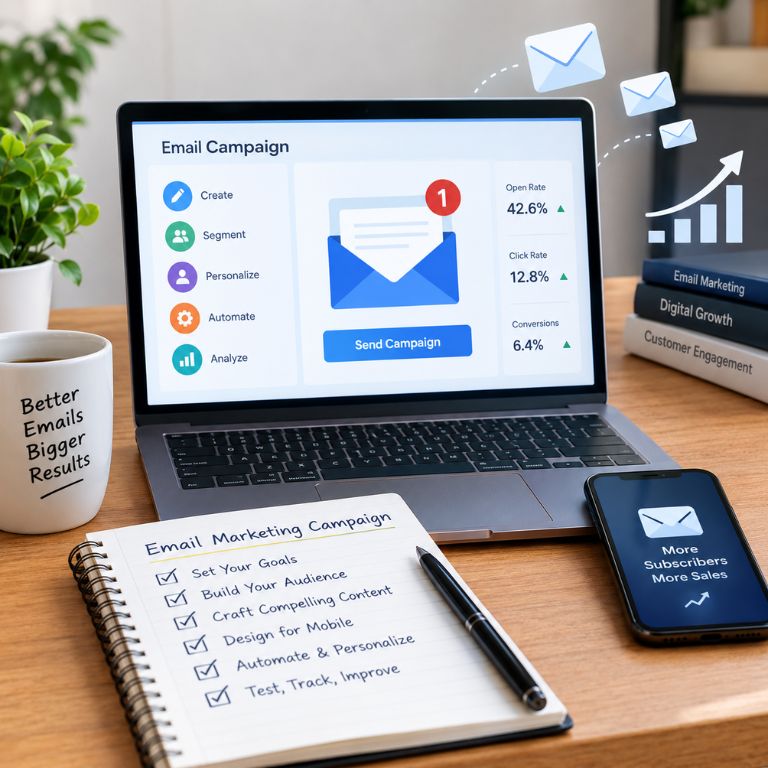
Email is still the highest-return channel most businesses own. Litmus puts the return at roughly $36 for every $1 spent, yet most inboxes are full of email campaigns that get opened, skimmed, and deleted. The difference between a newsletter people ignore and email marketing campaigns that drive revenue is not luck. It is strategy, segmentation, and testing.
In this guide, you will learn exactly how to create an email marketing campaign that converts in 2026, which metrics matter now that open rates are unreliable, and when it makes sense to bring in email marketing campaign services.
Why Email Marketing Campaigns Still Win in 2026
Social reach keeps shrinking and paid media keeps getting more expensive. Your email list is the one audience you own outright. No algorithm decides whether your subscribers see your message.
Three trends make email marketing campaigns more important this year:
- AI search is cutting website clicks – As Google AI Overviews and chat assistants answer questions directly, owned channels like email matter more for repeat traffic.
- Stricter sender rules reward good senders – Gmail and Yahoo’s bulk-sender requirements (authentication, one-click unsubscribe, low spam complaints) have pushed out sloppy competitors.
- Automation is now accessible – Even small businesses can run triggered email campaigns that used to require an enterprise budget.
Email Marketing Campaign Benchmarks
Use these figures to build charts in your post (bar or column charts work best). Figures are compiled from the sources listed at the end; verify against the original reports before publishing.
Average Click-Through Rate by Audience Type
| Audience | Avg. Click-Through Rate |
| B2B | 3.5% |
| All industries | 2.3% |
| B2C | 2.1% |
Source: Mailchimp benchmarks, via BounceZero 2026
Performance Lift from Proven Email Tactics
| Tactic | Lift vs. Baseline |
| Segmentation (click rate) | +101% |
| Personalized subject lines (open rate) | +26% |
| Segmentation (open rate) | +14.3% |
Sources: Mailchimp; Experian (via BounceZero 2026)
Where Emails Are Opened
| Device | Share of Opens |
| Mobile | 61% |
| Desktop & other | 39% |
Source: Litmus 2026 (via BounceZero)
Open Rate – Welcome Email vs. Average Campaign
| Email Type | Avg. Open Rate |
| Welcome email | 68% |
| Average campaign | 21.5% |
Sources: Return Path; Campaign Monitor (via BounceZero 2026). Note: open rates are inflated by Apple Mail Privacy Protection.
How to Create an Email Marketing Campaign That Converts: 8 Steps
Step 1: Set One Clear Goal Per Campaign
Every high-performing campaign starts with a single objective. Are you trying to drive a purchase, book a demo, recover abandoned carts, or re-engage cold subscribers? One email, one goal, one call-to-action (CTA).
Tie that goal to a measurable KPI, such as revenue per email, conversion rate, or demo bookings, not just opens.
Step 2: Build and Clean a Permission-Based List
Never buy lists. Purchased contacts damage deliverability and can breach privacy laws such as GDPR and CAN-SPAM. Grow your list with:
- Lead magnets (checklists, templates, mini-courses)
- Exit-intent pop-ups and embedded forms
- Gated webinars and free tools
- Checkout and account sign-up opt-ins
Then clean the list regularly. Remove hard bounces and long-term inactive contacts. A healthy list protects your sender reputation, and that decides whether your email campaigns reach the inbox at all.
Step 3: Segment Your Audience
Segmentation is the backbone of any strong email marketing campaign strategy. Mailchimp’s data shows segmented campaigns earn roughly double the clicks of unsegmented sends. Segment by:
- Lifecycle stage: new subscriber, active customer, lapsed buyer
- Behavior: pages viewed, products clicked, cart abandoned
- Demographics or firmographics: location, industry, company size
- Engagement level: frequent clickers vs. dormant contacts
Step 4: Write Subject Lines That Earn the Open
Your subject line is your headline. Keep it under 50 characters so it does not get cut off on mobile. Strong formulas include:
- Curiosity: “The 3-minute fix most stores ignore”
- Benefit: “Cut your ad spend by 20% this quarter”
- Urgency (used honestly): “Last chance: early-bird pricing ends tonight”
- Personalization: “[Name], your audit results are ready”
Pair it with a preview text that adds information instead of repeating the subject line.
Step 5: Design Mobile-First, Copy-Led Emails
With roughly 61% of opens on mobile, design for the phone first:
- Single-column layout
- Large, thumb-friendly CTA buttons
- Short paragraphs (two to three lines)
- Images with alt text, since many clients block images by default
- A healthy text-to-image ratio to avoid spam filters
Write like a person, not a brochure. Lead with the reader’s problem, show the benefit, and ask for one action.
Step 6: Automate Your Highest-Value Flows
Automated sequences outperform one-off sends because they arrive at the moment of intent. Klaviyo reports that automated flows drive about 21% of email revenue from just 2.1% of sends. Start with these five:
- Welcome series – (3–5 emails introducing your brand and best offer)
- Abandoned cart / abandoned browse
- Post-purchase – (onboarding, cross-sell, review request)
- Lead nurture – for B2B (education leading to a demo request)
- Win-back – for subscribers inactive 90+ days
Step 7: Nail Deliverability and Compliance
The best email is useless in the spam folder. Since 2024, Gmail and Yahoo require bulk senders to:
- Authenticate with SPF, DKIM, and DMARC
- Offer one-click unsubscribe
- Keep spam complaint rates below 0.3% (Google recommends under 0.1%)
Warm up new sending domains gradually and monitor reputation in Google Postmaster Tools.
Step 8: Test, Measure, and Optimize
Because Apple Mail Privacy Protection inflates opens, judge email marketing campaigns on:
- Click-to-open rate (CTOR)
- Conversion rate and revenue per recipient
- Unsubscribe and spam complaint rates
- List growth rate
A/B test one variable at a time: subject line, CTA copy, send time, or offer. Let tests reach a meaningful sample size before declaring a winner.
Combining Email Campaigns with Email Marketing Ads
Email marketing ads extend your reach beyond your own list in two ways:
- Sponsored newsletter placements: Buy ad slots in niche newsletters your audience already reads. This is one of the fastest ways to grow a targeted list.
- Retargeting with your list: Upload your email list as a Customer Match (Google) or Custom Audience (Meta, LinkedIn). Show ads to subscribers who opened but did not buy, or exclude existing customers from acquisition ads to save budget.
Running email and paid media together creates a full-funnel loop: ads drive sign-ups, and email campaigns turn those sign-ups into revenue.
Common Email Campaign Mistakes to Avoid
- Sending the same message to your entire list
- Hiding the unsubscribe link (this raises spam complaints)
- Multiple competing CTAs in one email
- Judging success on open rate alone
- Inconsistent sending followed by sudden large blasts
- Skipping a plain-text version and a mobile preview test
When to Hire Email Marketing Campaign Services
DIY works well early on. Consider professional email marketing campaign services when:
- Your list is over 5,000 contacts and deliverability is slipping
- You need advanced automation, such as ecommerce flows or B2B lead scoring
- Email revenue has plateaued despite consistent sends
- Your team lacks time for copywriting, design, and testing every week
A good agency handles strategy, segmentation, copy, design, automation, and reporting, so every send is tied to revenue. At Marketing Flavour, our content writing services and e-commerce marketing services help brands build email marketing campaigns that convert subscribers into customers.
Ready to turn your list into revenue? Talk to Marketing Flavour about a free email campaign audit.
Frequently Asked Questions (FAQs)
1. What are email marketing campaigns?
Email marketing campaigns are a planned series of emails sent to a targeted list to achieve a specific goal, such as driving sales, nurturing leads, or re-engaging subscribers. They can be one-off broadcasts or automated sequences triggered by user behavior.
2. How do I create an email marketing campaign from scratch?
To create an email marketing campaign, set one clear goal, build a permission-based list, segment your audience, write a strong subject line, design a mobile-first email with one CTA, automate key flows, check deliverability, and then test and optimize based on clicks and conversions.
3. What is the best email marketing campaign strategy for small businesses?
The best email marketing campaign strategy for small businesses is to start with a welcome series and an abandoned cart or lead-nurture flow, segment by engagement, and send consistent value-led emails. Automation lets a small team get enterprise-level results.
4. How often should I send email campaigns?
Most brands do well with one to two email campaigns per week, plus automated flows. Consistency matters more than volume. Watch unsubscribe and complaint rates; if they rise, reduce frequency or improve segmentation.
5. What is a good conversion rate for email marketing campaigns?
It varies by industry and goal, but benchmark clicks first: an average click-through rate of around 2–3% (higher for B2B) is a reasonable baseline. Track conversion rate and revenue per recipient against your own historical data.
6. What do email marketing campaign services include?
Email marketing campaign services typically include strategy, list growth, segmentation, copywriting, template design, automation setup, deliverability management, A/B testing, and performance reporting.
7. Are email marketing ads worth it?
Yes, when targeted well. Email marketing ads, such as sponsored newsletter placements and list-based retargeting on Google, Meta, or LinkedIn, grow your list and recover warm leads who did not convert from your email campaigns alone.
8. Why are my email campaigns going to spam?
Common causes include missing SPF, DKIM, or DMARC authentication, high complaint rates, purchased or outdated lists, spammy wording, and image-heavy designs. Fix authentication first, then clean your list and improve relevance.
References & Sources
- Litmus – The ROI of Email Marketing
- Mailchimp – Email Marketing Benchmarks
- Mailchimp – Email Marketing Statistics
- BounceZero – 57 Email Marketing Statistics for 2026
- MailBluster – Email Marketing Benchmarks 2026
- Google – Email Sender Guidelines
- Yahoo – Sender Requirements & Recommendations
- Google Postmaster Tools
- FTC – CAN-SPAM Act: A Compliance Guide for Business