
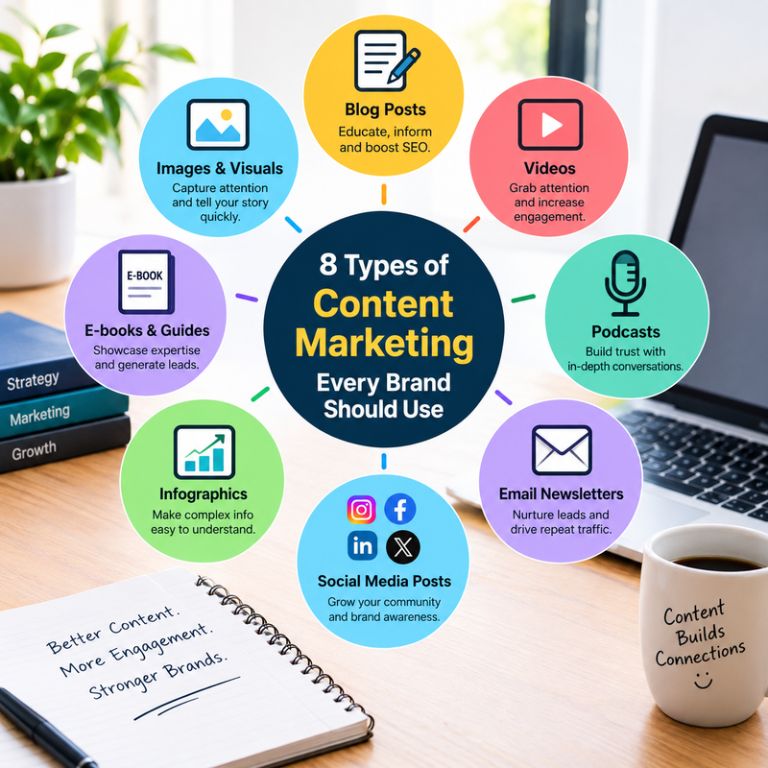
Content marketing is no longer about publishing a blog post and hoping Google notices. In 2026, buyers discover brands through AI Overviews, ChatGPT answers, TikTok searches, LinkedIn feeds and podcasts, often before they ever visit a website. That is why understanding the different types of content marketing is now a core business skill, not a nice-to-have.
The data backs this up. According to the Content Marketing Institute, 92% of B2B marketers used short articles and 76% used video in the past year, while 81% say their teams now use generative AI. Wyzowl reports that 91% of businesses use video for marketing.
But more content is not the answer. The brands winning today use a mix of formats, each matched to a stage of the buyer journey and backed by a clear content marketing strategy. In this guide from Marketing Flavour, we break down the 8 types of content marketing every brand should use, the latest trends shaping each one, and how to combine them for traffic, leads and revenue.
The 8 Types of Content Marketing Every Brand Should Use
1. Blog Posts and Long-Form Articles
Blogging is still the foundation of most content marketing programs. Well-researched articles answer the questions your audience types into Google and AI assistants, building organic traffic that compounds over time.
The 2026 shift: search engines and large language models reward depth, first-hand experience and clear structure. Pages with concise answers, FAQ sections and schema markup are more likely to be cited in AI Overviews and generative engine results.
- Best for: awareness, organic traffic, content marketing SEO
- Pro tip: build topic clusters, a pillar page linked to 8–12 supporting articles, to signal topical authority.
2. Video Content (Short-Form and Long-Form)
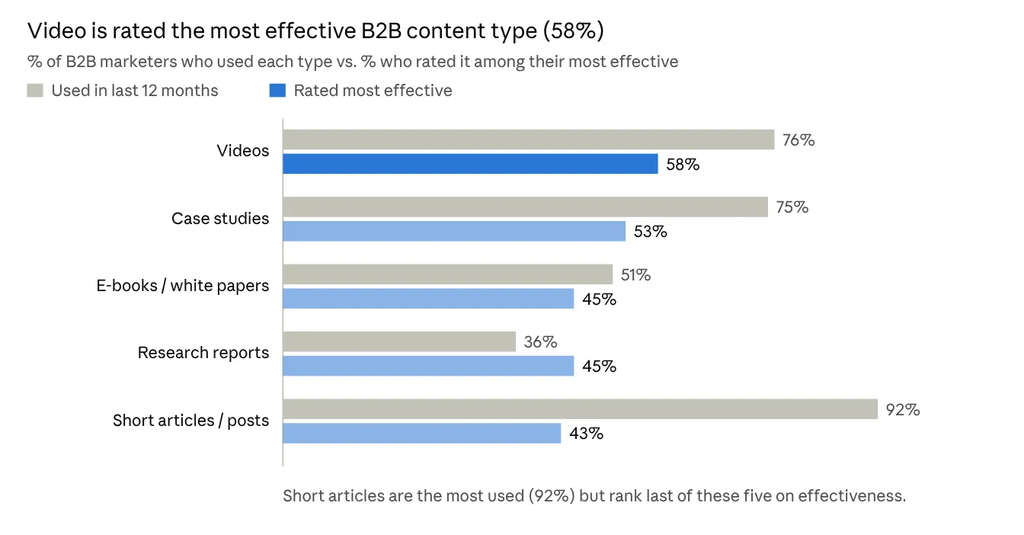
Video is the most engaging of all the types of content marketing. CMI found that B2B marketers rate video as their most effective format (58%), and Wyzowl reports 63% of consumers prefer learning about a product through a short video.
| Content Type | Used in Last 12 Months (%) | Rated Most Effective (%) |
| Videos | 76 | 58 |
| Case studies / customer stories | 75 | 53 |
| E-books / white papers | 51 | 45 |
| Research reports | 36 | 45 |
| Short articles / posts | 92 | 43 |
Supporting stats: 91% of businesses use video for marketing and 82% say it delivers good ROI (Wyzowl, 2026). 81% of B2B marketing teams now use generative AI (CMI).
Short-form video (Reels, TikTok, YouTube Shorts) drives reach, while long-form YouTube content builds trust and ranks in both Google and YouTube search.
- Best for: awareness, brand personality, product education
- Pro tip: repurpose one long video into 5–10 short clips, each with captions and a keyword-rich title.
3. Case Studies and Customer Stories
Case studies turn happy customers into proof. They show real problems, real solutions and measurable results, which is exactly what decision-makers need before buying. 53% of B2B marketers rate them among their most effective formats.
- Best for: consideration and decision stages, sales enablement, b2b content marketing
- Pro tip: lead with the result in the headline (for example, “How X cut onboarding time by 40%”).
4. Ebooks, White Papers and Guides
Gated long-form assets are the classic lead magnet. A detailed guide or white paper exchanges real value for an email address, feeding your nurture sequences and sales pipeline.
- Best for: lead generation, thought leadership
- Pro tip: publish an ungated summary blog post so the topic still ranks and earns links.
5. Original Research and Data Reports
Proprietary data is one of the most link-worthy types of content marketing. Journalists, bloggers and AI models cite statistics, so a single survey or industry benchmark can earn backlinks and brand mentions for years.
- Best for: authority, backlinks, PR, GEO and AI citations
- Pro tip: turn every key stat into a shareable chart and a quotable sentence.
6. Infographics and Visual Content
Visual content simplifies complex ideas and spreads quickly on Pinterest, LinkedIn and Instagram carousels. Infographics, charts and carousels also earn embeds and backlinks.
- Best for: social sharing, explaining processes, link building
- Pro tip: add descriptive alt text and an embed code so others can share it with credit.
7. Podcasts and Audio Content
Podcasts build deep loyalty because listeners spend 30–60 minutes with your brand. Video podcasts now double as YouTube content, and guest appearances open new audiences.
- Best for: thought leadership, relationship building, niche authority
- Pro tip: publish transcripts and show notes on your site to capture search traffic.
8. Social Media, Email and Interactive Content
Social posts, newsletters and interactive tools (quizzes, calculators, assessments) keep your audience engaged between bigger campaigns. Email remains the channel you own, free from algorithm changes, while interactive content collects zero-party data.
- Best for: engagement, retention, community, conversions
- Pro tip: use social posts to distribute every other content type on this list, not just to post in isolation.
How to Build a Content Marketing Strategy That Uses All 8 Types
Knowing the types of content marketing is step one. Turning them into growth requires a documented content marketing strategy:
- Define goals and KPIs – Traffic, leads, pipeline or retention, pick one primary goal per quarter.
- Map content to the funnel – Blogs, video and social for awareness; guides and webinars for consideration; case studies and demos for decisions.
- Research keywords and questions – Target what buyers search on Google, YouTube and AI chat tools.
- Create once, repurpose everywhere – One research report can become a blog post, an infographic, five social posts, a podcast episode and a newsletter.
- Measure and refine – Track rankings, AI citations, engagement and conversions monthly, then double down on what works.
B2B Content Marketing: What Works Best
B2B content marketing has longer sales cycles and multiple decision-makers. The highest-performing formats are case studies, white papers, original research, webinars and LinkedIn thought leadership. Focus on solving specific problems for specific roles, and give your sales team content they can send directly to prospects.
Content Marketing SEO: Making Every Type Discoverable
Content marketing SEO ensures your content actually gets found. Key 2026 practices include:
- Optimise titles, meta descriptions, headers and URLs for your target keywords.
- Add FAQ, Article, Video and HowTo schema markup.
- Write clear, direct answers near the top of each page for AI Overviews and GEO.
- Build internal links between related content and earn backlinks with data and visuals.
- Show E-E-A-T: author bios, first-hand experience, cited sources and updated dates.
Should You Hire One of the Best Content Marketing Agencies?
If your team lacks time or expertise, partnering with one of the best content marketing agencies can speed up results. Look for an agency with proven case studies in your industry, combined SEO and content skills, transparent reporting and experience with AI search optimisation. Marketing Flavour helps brands plan, create and rank content across all eight formats.
Conclusion
The most successful brands do not rely on one format. They combine blogs, video, case studies, guides, original research, visuals, podcasts and social or email content into one connected system. Start with two or three types of content marketing that fit your audience and resources, measure results, then expand.
With a clear content marketing strategy and strong content marketing SEO, every piece you publish works harder, ranking in search, getting cited by AI and converting readers into customers.
Ready to grow with content? Contact Marketing Flavour for a free content audit and a custom strategy built around the formats that will move your numbers.
FAQs About Types of Content Marketing
1. What are the main types of content marketing?
The main types of content marketing are blog posts, video, case studies, ebooks and white papers, original research, infographics, podcasts, and social media, email and interactive content.
2. How do I create a content marketing strategy?
Set clear goals, define your audience, research keywords, map content types to each funnel stage, create a publishing calendar, distribute across channels and track KPIs monthly.
3. Which type of content marketing works best for B2B?
In b2b content marketing, video, case studies, white papers and research reports are rated most effective, because they build trust with multiple decision-makers over long sales cycles.
4. How does content marketing SEO help my business?
Content marketing SEO makes your content discoverable in Google and AI search. Optimised content earns organic traffic, backlinks and AI citations without ongoing ad spend.
5. How many types of content marketing should a brand use?
Start with two to three formats you can produce consistently, then add more as you learn what your audience engages with. Repurposing helps you cover more types with less effort.
6. Is content marketing still effective in 2026?
Yes. AI search has raised the bar for quality, but brands that publish expert, original and well-structured content are more visible than ever across search, social and AI assistants.
References & Sources
- B2B Content Marketing Benchmarks, Budgets, and Trends: Outlook for 2025 – Content Marketing Institute
- Video Marketing Statistics 2026 – Wyzowl, State of Video Marketing
- The Most Effective Types of Content on Social Media – HubSpot
- Video Marketing Statistics – HubSpot
- B2B Content Marketing Statistics – ZoomInfo
- Creating Helpful, Reliable, People-First Content – Google Search Central