

SEO in 2026 doesn’t look like SEO five years ago. AI Overviews, AI Mode, and generative engines now sit between your website and the searcher, LLMs summarize your content before a visitor ever clicks through, and Google Search Console itself now reports on AI visibility. In the middle of all this change, two questions keep coming up from site owners doing AI SEO content optimization: should content be written differently for every platform it appears on, and how many times can you actually repeat a keyword before it starts working against you? Below, we break down both, with a practical framework you can apply to your own site today.
How AI Is Reshaping Website SEO in 2026
Search is no longer a single destination. A single piece of content might be read by Google’s classic crawler, summarized by an AI Overview, shared on LinkedIn, discussed on Reddit, and pulled into a chatbot’s answer all from one URL. That means your metadata, structure, and even your writing style are doing more jobs than before: ranking in classic search, getting cited in AI-generated answers, and still reading naturally to a human. Getting platform-specific SEO and on-page SEO best practices right at the same time is now the real skill, not a nice-to-have.
Should You Optimize Content Differently for Each Platform?
Yes, and the difference isn’t just tone, it’s structure. Each platform has its own display limits, audience intent, and algorithmic priorities, so a single one-size-fits-all page rarely performs everywhere.
Metadata differs by platform – Search engines truncate titles and descriptions by pixel width, not character count, while social platforms like LinkedIn, Pinterest, and Open Graph consumers cap by character length. A title that looks perfect in a Google snippet can get cut off or look awkward as a LinkedIn share card. The fix is writing unique meta titles, descriptions, and Open Graph tags per channel rather than reusing the same string everywhere.
Images need platform-appropriate framing – A vertical infographic that performs well on Pinterest becomes illegible as a square Instagram tile or a wide Facebook link preview. Resize and recrop your featured image so the focal point still reads clearly at the aspect ratio each platform actually displays.
On-page content can serve two audiences without competing – Not every page needs to be pure SEO copy. A visitor arriving from a search engine already understands the product and wants a fast answer; a visitor from social media may need more context before converting. You can run both experiences off the same core keyword using schema, canonical tags, or a noindex,follow directive on a remarketing or social-landing variant so you’re not cannibalizing your own rankings while still tailoring the experience.
What you post to the platform is different again – Reddit and LinkedIn audiences respond to detailed, credible write-ups with a clear takeaway; a Facebook post or a YouTube Short works better as a short hook that drives a click. Match the format and word count to what that platform’s algorithm and its readers actually reward, then send everyone back to a website page written for conversion or education, depending on their intent.
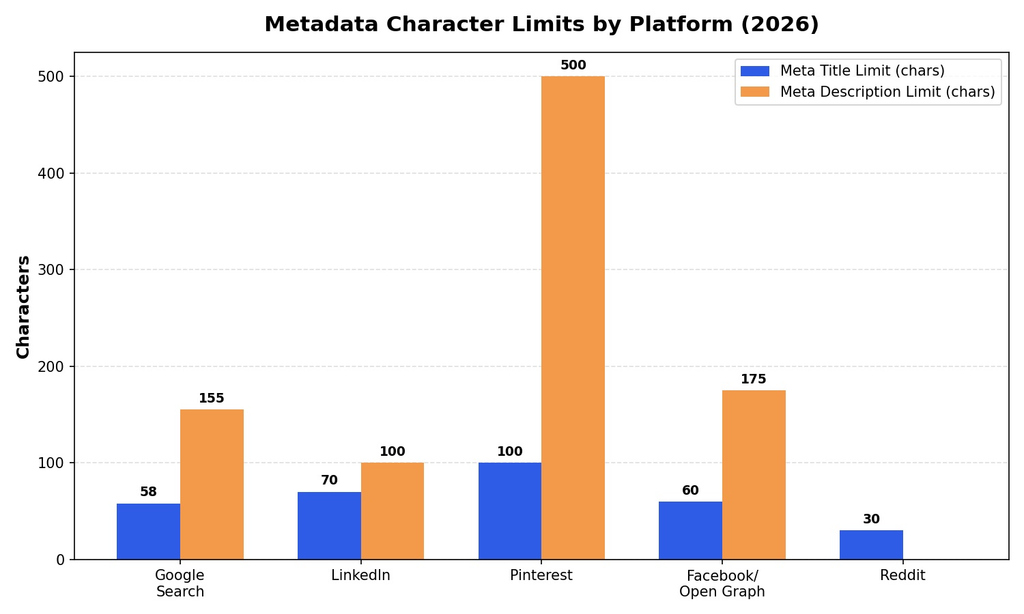
Platform Metadata & Content Comparison
| Platform / Surface | Meta Title Limit | Meta Description Limit | Content Style That Performs |
| Google Search | ~55–60 characters (pixel-based) | ~150–160 characters | Clear, benefit-led, no clickbait |
| Google AI Overviews / AI Mode | N/A (structured content) | N/A | Direct answers, definitions, structured headers |
| ~70 characters | ~100 characters | Educational, data-backed, professional tone | |
| ~100 characters | ~500 characters | Vertical imagery, keyword-rich descriptions | |
| Post title only | N/A | Honest, unbiased, community-first tone | |
| Facebook / Open Graph | ~60–95 characters | ~155–200 characters | Short hook + strong CTA |
What Is the Threshold Between Keyword Stuffing and Being Optimized?
There isn’t a fixed number. “Keyword density” scores from SEO tools are a third-party measurement, not an actual Google or AI ranking signal search engines stopped rewarding raw repetition years ago. Since Google’s Panda update devalued thin, repetitive content, and later BERT and MUM improvements taught search systems to understand context, synonyms, and relationships between terms, exact-match repetition has mattered far less than clarity and structure.
A simple working definition: keyword stuffing is forcing a keyword or phrase into content, headers, and URLs for the sole purpose of manipulating rankings, at the cost of readability. Keywords still matter; they signal topic relevance in your H1, a handful of H2s, internal links, title tags, schema, and the URL but forcing the exact phrase into every heading and paragraph hurts the user experience without adding ranking value that modern algorithms actually reward.
A useful mental model: let your H1 carry the primary topic, and let your H2s cover natural sub-topics using synonyms and related terms rather than repeating the exact phrase. If your H1 is about “content optimization,” your H2s might be “metadata strategy,” “keyword placement,” or “avoiding stuffing” the search engine and the reader both understand the connection without you repeating the head term five times. This is also exactly how GEO (Generative Engine Optimization) works: AI systems reward well-structured, topically coherent pages over keyword-dense ones when deciding what to cite.
Illustrative Keyword Placement Guide (Not a Hard Rule)
| Page Element | Recommended Approach | Stuffing Red Flag |
| Title Tag / H1 | Primary keyword once, near the front | Keyword repeated 2+ times |
| H2 Subheadings | Related terms & synonyms, not exact repeats | Same exact phrase in every H2 |
| Body Copy (1,000–1,500 words) | Keyword + variants appear naturally 4–8 times | Same phrase forced every 100 words |
| URL Slug | Primary keyword, short and readable | Multiple keywords stacked in one slug |
| Image Alt Text | Descriptive, includes keyword only if accurate | Keyword stuffed into every alt tag on the page |
| Footer / Navigation Links | Clear, minimal, brand-focused | Long lists of exact-match anchor text links |
A Practical Checklist to Get Indexed Faster in Google Search Console
Great content still needs to be technically discoverable. Pair the writing guidance above with these basics so new posts get crawled and indexed quickly:
- Submit the URL manually via GSC’s URL Inspection tool after publishing.
- Keep the post inside your XML sitemap and resubmit the sitemap after major content updates.
- Use one clear H1, a logical H2/H3 hierarchy, and internal links from existing indexed pages to the new post.
- Avoid duplicate or near-duplicate content thin, templated pages are a leading cause of “Crawled – currently not indexed” status.
- Compress the featured image (1080 x 616px works well for most blog templates) and add descriptive alt text.
- Add Article or BlogPosting schema markup so AI systems and Google can parse the content structure.
- Keeping meta titles and descriptions unique per page duplicate metadata across the site confuses both crawlers and readers.
Put Platform-Specific SEO Into Practice With Marketing Flavour
Ready to build metadata, content, and structure that performs across every platform, not just Google? Explore the full range of services at Marketing Flavour.
Getting cross-platform metadata, GEO readiness, and technical SEO working together takes a coordinated plan, see how our digital marketing strategy services bring content structure, schema, and search strategy into one approach.
Looking for hands-on execution closer to home? Explore our digital marketing services in Cincinnati for locally-focused technical SEO and content support.
Come across a term like GEO or E-E-A-T and want it explained plainly? Get a clear breakdown in What Is UBC in Digital Marketing?
Want to see the full range of services that support content strategy and indexing health together? Browse our complete list of digital marketing services.
Getting your content platform-ready for LinkedIn, Pinterest, and Reddit takes consistent execution, check out our social media management services to keep every channel-specific version performing.
FAQs
Should I write different content for every social platform?
Not for every page, but yes for your most important ones. At minimum, customize the metadata, image crop, and the snippet you share publicly for each platform, since audiences and algorithms reward different formats.
What is keyword stuffing in SEO?
Keyword stuffing is forcing a keyword or phrase into headers, body copy, or URLs repeatedly for the sole purpose of manipulating rankings, rather than to help the reader.
Is there an ideal keyword density percentage?
No fixed percentage is confirmed by search engines. Keyword density scores come from third-party SEO tools, not from Google, AI Overviews, or LLM ranking systems directly.
Do I need the exact keyword in every H2?
No. Placing the primary keyword in the H1 and using related terms or synonyms in H2s is generally enough for search engines to understand the page’s topic.
How does AI change on-page SEO in 2026?
AI Overviews and generative engines favor clearly structured, well-organized content that answers a question directly, which is why GEO and classic SEO increasingly reward the same clean, non-stuffed writing style.
References & Sources
- Riemer, A. (2026). Should I Optimize My Content Differently For Each Platform? Search Engine Journal.
- Riemer, A. (2025). Ask An SEO: What Is The Threshold Between Keyword Stuffing & Being Optimized? Search Engine Journal.
- Google Search Central. How Google Search Works
- Google Search Central. Keyword Stuffing