
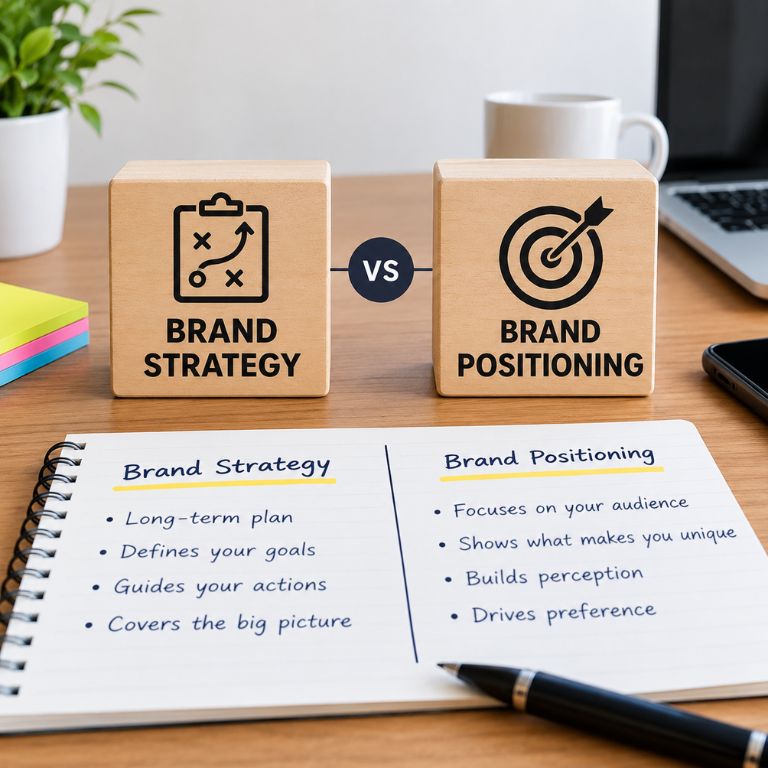
Branding and positioning are two of the most used words in marketing, and two of the most misunderstood. Founders say “we need a new brand strategy” when they really mean “nobody knows why we are different.” Agencies sell “positioning workshops” that end up as logo refreshes.
The short answer: brand strategy is the long-term plan for who your brand is and how it grows. Brand positioning is the specific place you want to own in your customer’s mind compared with competitors. Strategy is the map. Positioning is the flag you plant on it.
Getting this difference right matters more in 2026 than ever. Customers now meet brands through AI answers, short-form video and search results before they ever see a homepage. If your brand strategy and positioning are vague, AI tools and buyers will both describe you vaguely. In this guide, we break down each concept, compare them side by side, and give you a practical framework to build both.
What Is a Brand Strategy?
Brand strategy is the long-term, company-wide plan that defines what your brand stands for, who it serves and how it will build recognition and loyalty over years, not weeks. It guides every decision, from hiring and pricing to content and customer service.
A complete brand strategy usually covers:
- Purpose and mission: why the business exists beyond making money.
- Vision and values: where the brand is going and the principles it will not compromise on.
- Target audience: the customer segments you choose to serve, and those you ignore.
- Brand personality and voice: how the brand sounds and behaves everywhere.
- Brand architecture: how products, sub-brands and services relate to each other.
- Digital brand identity: your logo, colors, typography, website experience and social presence working as one system.
- Growth and measurement: awareness, consideration and loyalty targets tracked over time.
Think of brand strategy as the operating system. It does not change every quarter. A good brand strategy holds for 3–5 years and gives every team the same reference point. Positioning is one critical app that runs on top of it.
What Is Brand Positioning?
Brand positioning is the distinct, valuable place your brand occupies in the minds of a target audience relative to competitors. The idea was popularised by Al Ries and Jack Trout, who argued that positioning is not what you do to a product but what you do to the mind of the prospect.
A strong brand positioning strategy answers four questions in one sentence:
- Who is the target customer?
- What category or frame of reference do you compete in?
- Why are you different and better (your point of difference)?
- What proof makes that claim believable?
A classic positioning statement template looks like this:
For [target customer] who [need], [brand] is the [category] that [key benefit], because [reason to believe].
Example for a digital agency: For growing D2C brands that waste ad spend, Marketing Flavour is the performance marketing partner that ties every campaign to revenue, because every account runs on full-funnel analytics.
Positioning is sharper and narrower than strategy. It can shift when markets move, a competitor copies you, or you enter a new segment, while the wider brand strategy stays steady.
Brand Positioning vs Brand Strategy: Key Differences
The simplest way to separate branding and positioning is by scope, timeframe and owner.
| Factor | Brand Strategy | Brand Positioning |
| Core question | Who are we and where are we going? | Why should a customer choose us over X? |
| Scope | Whole business and all touchpoints | One market, segment or competitive set |
| Timeframe | 3–5+ years | Revisited every 12–24 months |
| Output | Brand platform, values, architecture, identity guidelines | Positioning statement, value proposition, key messages |
| Owner | Leadership + brand team | Marketing + product marketing |
| Focus | Internal alignment and long-term equity | External perception and differentiation |
| Success metric | Brand equity, loyalty, pricing power | Share of mind, conversion rate, win rate |
In short, brand strategy and positioning are not competitors. Positioning is a component of brand strategy, and the most visible one to customers.
Revenue lift from consistent brand presentation
| Study wave | Average revenue lift (%) | Source |
| 2016 | 23 | Lucidpress / Demand Metric |
| 2019 | 33 | Lucidpress (Marq) |
How Brand Strategy and Positioning Work Together
Strategy without positioning is a nice mission statement nobody remembers. Positioning without strategy is a clever tagline with nothing behind it. The two need each other.
Here is how the layers connect:
- Brand strategy – sets the purpose, audience and values.
- Brand positioning – picks the competitive space where you will win.
- Marketing strategy and positioning – turn that space into channels, offers, budgets and campaigns.
- Digital brand identity – expresses all of it visually and verbally across your website, ads and social feeds.
Where marketing strategy and positioning fit
Marketing strategy is the short-to-mid-term plan for reaching customers: SEO, paid ads, content, email and social. When marketing strategy and positioning are aligned, every campaign repeats the same core idea. When they are not, you get mixed messages, higher ad costs and lower conversion.
The Brand Consistency Gap
| Metric | Share of organizations (%) | Source |
| Have brand guidelines | 85 | Marq |
| Consistently enforce them | 30 | Marq |
| Deal with off-brand content | 77 | Marq |
| Say consistency drove 10–20%+ of growth | 68 | Lucidpress |
This is also why consistency pays. Research from Lucidpress (now Marq) links consistent brand presentation to an average revenue lift of 23% in its 2016 study and up to 33% in its 2019 study. You cannot be consistent about a position you never defined.
Trending in 2026: Positioning for AI Search and GEO
The biggest shift in branding and positioning this year is that customers increasingly hear about you from an AI first. Google AI Overviews, ChatGPT, Perplexity and Gemini summarise brands in a sentence or two. That summary is your positioning, whether you wrote it or not.
Generative Engine Optimization (GEO) is the practice of making your brand easy for AI systems to understand, trust and cite. A clear brand positioning strategy is now a GEO asset because AI models repeat what is stated consistently across many sources.
To position your brand for AI search:
- Use one positioning sentence everywhere: homepage, About page, LinkedIn, Google Business Profile and directory listings.
- Own a category phrase: “performance marketing agency for D2C brands” is easier for AI to cite than “360° digital solutions.”
- Publish proof: case studies, data, reviews and expert content that support your point of difference.
- Add structured data: Organization, Service and FAQ schema help machines read your digital brand identity.
- Earn third-party mentions: PR, podcasts and industry roundups reinforce the same message off-site.
The brands that win AI answers are not the loudest. They are the clearest.
How to Build Your Brand Strategy and Positioning: 6 Steps
- Audit where you stand – Review your website, ads, reviews and AI search answers. Ask 10 customers why they chose you. Their words often reveal your real position.
- Define the brand foundation – Write your purpose, vision, values and personality. Keep each to one or two lines so teams can remember them.
- Map the competition – List 5–8 competitors and plot them on two axes that matter to buyers, such as price vs specialisation. Look for empty, valuable space.
- Write your positioning statement – Use the template above. Test it with sales staff and real customers. If they cannot repeat it, simplify it.
- Build your digital brand identity – Align logo, color, typography, tone of voice and website UX with the position. Our Brand Identity guide covers this step in depth.
- Activate through marketing strategy and positioning – Turn the position into SEO topics, ad angles, social content pillars and sales scripts. Track brand search volume, conversion rate and share of AI mentions every quarter.
Recommended budget split
| Activity | Share of budget (%) | Source |
| Long-term brand building | 60 | Binet & Field, IPA |
| Short-term sales activation | 40 | Binet & Field, IPA |
Binet and Field’s research for the IPA suggests roughly a 60:40 split between long-term brand building and short-term activation for many businesses. Brand strategy protects the 60; positioning makes the 40 convert, especially in B2B lead generation, where buyers compare several vendors before shortlisting one.
Common Mistakes to Avoid
- Treating a logo redesign as brand strategy. Visuals express strategy; they do not replace it.
- Positioning on “quality” or “great service.” Every competitor claims these. Choose something specific and provable.
- Trying to appeal to everyone. A brand positioning strategy gets stronger when you say no to some customers.
Brand Strategy vs Positioning Focus
| Dimension | Brand Strategy | Brand Positioning |
| Long-term vision | 10 | 5 |
| Competitive differentiation | 6 | 10 |
| Internal alignment | 9 | 5 |
| Customer perception | 7 | 10 |
| Flexibility to change | 3 | 8 |
| Visual identity | 9 | 4 |
- Changing the message every campaign. Inconsistency resets recognition and raises acquisition costs.
- Ignoring AI and search visibility. If AI tools cannot describe your position clearly, many buyers will never hear it.
Conclusion: Get the Strategy Right, Then Own Your Position
The difference between branding and positioning is simple once you see it. Brand strategy defines who you are and where you are going. Brand positioning defines why customers should choose you right now. Marketing strategy and positioning bring that choice to market, and your digital brand identity makes it recognisable everywhere.
Get all four aligned and your marketing becomes cheaper, clearer and easier for both humans and AI to remember.
Need help sharpening your brand strategy and positioning? Talk to Marketing Flavour about a brand audit, positioning workshop and SEO plan built around a position you can actually own.
Frequently Asked Questions
1. What is the difference between branding and positioning?
Branding is the full system of identity, values and experience that shapes how people perceive a business. Positioning is one part of branding: the specific, differentiated place you aim to own in customers’ minds versus competitors.
2. What is a brand positioning strategy?
A brand positioning strategy is the plan for which audience you target, which category you compete in, what makes you different, and what proof backs it up. It is usually summarised in a one-sentence positioning statement.
3. Which comes first: brand strategy or positioning?
Brand strategy comes first. It sets the purpose, audience and values. Positioning is then chosen within that framework, so brand strategy and positioning stay consistent.
4. How do marketing strategy and positioning relate?
Positioning decides what you want to be known for. Marketing strategy decides how you communicate it through SEO, ads, content, email and social. Aligned marketing strategy and positioning lower ad costs and raise conversion.
5. What is digital brand identity?
Digital brand identity is how your brand looks, sounds and behaves online: logo, colors, typography, website, social profiles and tone of voice. It should visually express your brand positioning.
6. How often should brand positioning be updated?
Review positioning every 12–24 months, or sooner if a competitor copies you, your audience shifts or you launch into a new market. Core brand strategy usually holds for 3–5 years.
7. Does brand positioning affect SEO and AI search?
Yes. Clear, consistent positioning helps search engines and AI tools understand what you do and who you serve, making it more likely your brand is cited in AI Overviews and chatbot answers.
References & Sources
- Ries, A. & Trout, J. (1981). Positioning: The Battle for Your Mind. McGraw-Hill.
- Lucidpress / Demand Metric (2016) and Lucidpress (2019), State of Brand Consistency reports – revenue lift of 23% and 33%; 68% of companies attributing 10–20%+ of growth to consistency. Summarised at Omnibound: Brand Consistency Statistics and Review42: Branding Statistics.
- Marq, State of Brand Consistency – 85% have guidelines, 30% enforce them, 77% deal with off-brand content. Summarised at Emulent.
- Binet, L. & Field, P. (2013). The Long and the Short of It: Balancing Short and Long-Term Marketing Strategies. IPA, London – 60:40 brand-to-activation guideline.
- Kotler, P. & Keller, K. L. Marketing Management (Pearson) – positioning and brand equity frameworks.
- Google Search Central – Structured data documentation for Organization and FAQ schema.