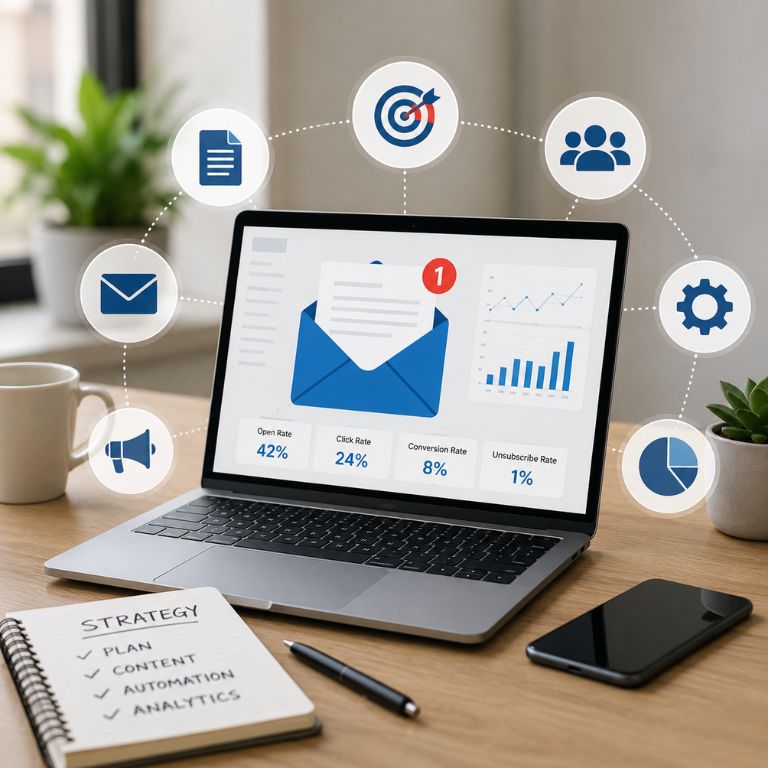
Email still delivers the highest return of any digital channel, but running it well takes more than sending a monthly newsletter. Strategy, list health, design, deliverability, segmentation, and automation all have to work together which is exactly why more brands are handing the whole function to a full service email marketing agency instead of piecing it together in-house.
This guide walks through what these agencies actually do, how to evaluate email marketing platforms, what good email marketing services include, and how automation turns a list of subscribers into a predictable revenue channel.
What Is a Full Service Email Marketing Agency?
A full service email marketing agency manages the entire email program end-to-end strategy, copywriting, design, list segmentation, deliverability, automation, reporting, and testing rather than handling just one piece of it. Instead of hiring a freelance designer for templates, a separate person for copy, and someone else to manage your ESP, one team owns the full lifecycle: welcome sequences, promotional campaigns, cart-abandonment flows, re-engagement journeys, and the reporting that ties it all back to revenue.
This matters because email underperforms when it’s treated as a checkbox task. A campaign with strong subject lines but poor segmentation still lands in the wrong inbox at the wrong time. A beautifully designed template with no automation behind it still leaves revenue on the table from abandoned carts and lapsed customers. A full-service model exists specifically to close those gaps.
Why Businesses Outsource to a Full Service Email Marketing Agency
Email marketing ROI is too high to manage part-time – Industry benchmarks consistently put email’s average return between $36 and $42 for every $1 spent well ahead of SEO, content marketing, paid search, and social media. That gap alone is why serious teams give it dedicated ownership rather than treating it as an afterthought squeezed between other marketing tasks.
Deliverability is a specialized skill – Getting into the inbox instead of the spam folder involves domain authentication (SPF, DKIM, DMARC), sender reputation management, list hygiene, and engagement-based sending all things a dedicated agency actively monitors, but an internal generalist team often overlooks until open rates quietly collapse.
Automation requires ongoing strategy, not a one-time setup – Welcome flows, abandoned-cart sequences, post-purchase nurtures, win-back campaigns, and lifecycle segmentation all need testing and refinement over time. A full service agency treats automation as a living system, continuously optimized against real performance data.
Platform expertise saves money – Agencies that work across multiple email marketing platforms daily know which tool fits which business model, so you’re not paying for enterprise features you’ll never use or outgrowing a starter plan within six months.
Email Marketing ROI vs. Other Digital Channels (Per $1 Spent)
| Channel | Average ROI per $1 |
| Email Marketing | $36–$42 |
| SEO | ~$22 |
| Content Marketing | ~$14 |
| Social Media Marketing | ~$10 |
| Paid Search (Google Ads) | ~$8 |
| Display Advertising | ~$5 |
Core Services a Full Service Email Marketing Agency Should Offer
- Strategy & audit – reviewing your existing list, past campaign performance, and customer lifecycle to build a roadmap rather than guessing at send frequency.
- Copywriting & design – subject lines, preview text, and mobile-first templates built to match your brand and convert on any device.
- List segmentation – grouping subscribers by behavior, purchase history, or engagement level so messages stay relevant instead of generic.
- Marketing automation – welcome series, abandoned-cart flows, post-purchase sequences, birthday/anniversary triggers, and win-back campaigns running on autopilot.
- Deliverability management – authentication setup, sender score monitoring, and list-cleaning to keep emails out of spam folders.
- A/B testing & reporting – testing subject lines, send times, and content blocks, then reporting back on open rate, click-through rate, and revenue attribution — not just vanity metrics.
- Platform migration & management – moving your data cleanly between email marketing platforms when a business outgrows its current tool.
A full service email marketing agency will typically recommend a platform based on your existing tech stack and growth stage, then handle the migration and ongoing management so your internal team isn’t stuck learning a new system mid-campaign.
How to Build an Email Marketing Strategy, Step by Step
A strong email marketing strategy is built in layers, not written as one document and left alone. Here’s the order that works:
- Define the goal for each email type – A welcome series, a promotional blast, and a re-engagement campaign all need different KPIs that don’t measure them the same way.
- Segment your list before you write a single subject line – Behavior, purchase history, and engagement level matter more than demographics alone.
- Map the customer journey – New subscriber → nurture sequence → conversion offer → post-purchase follow-up → loyalty/win-back. Each stage needs its own email.
- Write for one reader, not a crowd – Subject lines and body copy that sound like a person, not a brand broadcast, consistently out-open templated corporate copy.
- Test relentlessly – Subject lines, send times, and CTA placement should all be A/B tested; what works for one list rarely transfers perfectly to another.
- Protect deliverability – Authenticate your domain with SPF, DKIM, and DMARC, and clean your list regularly. A high bounce rate hurts your sender reputation across every future send.
- Review and refine monthly – Open rates, click-through rates, and unsubscribe trends tell you what’s working long before revenue numbers catch up.
Choosing the Right Email Marketing Platforms
Not all email marketing platforms are built for the same job, and picking the wrong one is one of the most common and expensive mistakes businesses make. A small newsletter creator has very different needs than an ecommerce brand running abandoned-cart flows for 50,000 contacts.
When evaluating email marketing platforms, weigh these factors:
- Automation depth – behavioral triggers, multi-step nurture sequences, and lifecycle automation, not just basic autoresponders.
- AI personalization – predictive send times, dynamic content, and smart segmentation that improves open and click rates over time.
- Integration ecosystem – native connections to your CRM, ecommerce platform, and analytics stack matter more long-term than a flashy template library.
- Deliverability tools – built-in authentication support and list-hygiene features protect your sender reputation.
- Pricing that scales – a cheap entry price that becomes unaffordable at 20,000 contacts isn’t actually cheap.
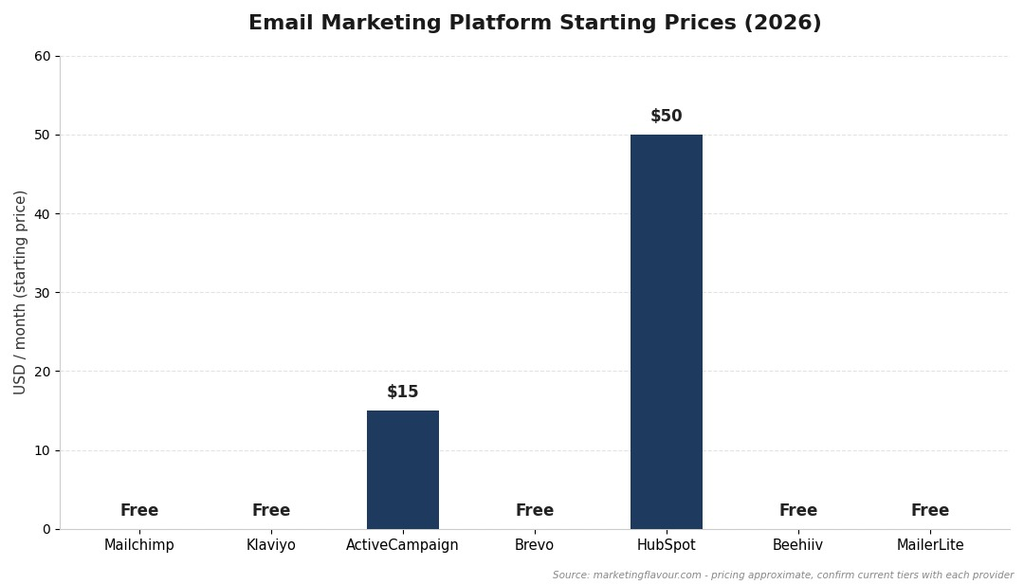
Email Marketing Platform Comparison (2026)
| Platform | Starting Price | Best For | Standout Feature |
| Mailchimp | Free – $350/mo | Small businesses & beginners | Large free tier + integration ecosystem |
| Klaviyo | Free – $150/mo | Ecommerce brands | Deep ecommerce & Shopify integration |
| ActiveCampaign | $15 – $145/mo | Advanced automation needs | Best-in-class workflow builder |
| Brevo | Free – custom | High-volume senders | Contact-unlimited, send-based pricing |
| HubSpot | From $50/mo | CRM-led B2B teams | Native CRM + reporting |
| Beehiiv | Free – paid tiers | Newsletter creators | Built-in monetization tools |
| MailerLite | Free – low-cost paid | Ease of use, small lists | Simple drag-and-drop builder |
Pricing is approximate and changes frequently always confirm current tiers directly with the provider before committing.
Email Marketing Automation Explained
Automation is what separates a modern email marketing strategy from a manual newsletter habit. Instead of sending one email to everyone at once, automation triggers the right message based on subscriber behavior:
- Welcome sequences – fire the moment someone joins your list, introducing your brand while intent is highest.
- Abandoned cart flows – recover revenue automatically for ecommerce brands, often within a few hours of the drop-off.
- Behavioral triggers – send follow-ups based on what a subscriber clicked, viewed, or ignored.
- Lifecycle automation – moves a contact through onboarding, engagement, retention, and win-back stages without manual intervention.
- Predictive send-time optimization – uses AI to send each individual subscriber’s email when they’re statistically most likely to open it.
Automation reduces manual workload while improving consistency the same nurture sequence runs correctly for subscriber #1 and subscriber #100,000.
In-House Team vs. Professional Email Marketing Services
Some businesses build and manage email marketing internally; others bring in professional email marketing services. The right choice usually comes down to volume, complexity, and internal bandwidth.
Running it in-house works well when:
- Your list and campaign cadence are manageable with existing staff time.
- You already have design and copywriting resources.
- Your automation needs are relatively simple.
Outsourcing to email marketing services makes sense when:
- You need multi-step automation, segmentation, and A/B testing set up correctly the first time.
- Deliverability has become a recurring problem.
- You want ongoing strategy, not just occasional campaign sends.
- Your team’s time is better spent on product, sales, or other core work.
A good email marketing services provider brings platform expertise, copywriting, deliverability management, and reporting under one roof which often pays for itself through better open rates and fewer unsubscribes alone.
Average Email Marketing Benchmarks by Metric
| Metric | Typical Benchmark Range |
| Average Open Rate | 20% – 35% |
| Average Click-Through Rate | 2% – 5% |
| Average Unsubscribe Rate | Under 0.5% |
| Average ROI | $36 return per $1 spent |
| List Growth (healthy monthly rate) | 2% – 5% |
Ready to Build an Email Channel That Actually Converts? Marketing Flavour Can Help
Looking to turn email from an afterthought into a structured revenue channel? Explore the full range of services at Marketing Flavour.
Email performs best when it’s tied to a broader plan, not run in isolation, see how our digital marketing strategy services bring email, content, and paid channels together around the same customer journey.
Looking for hands-on execution closer to home? Explore our digital marketing services in Cincinnati for locally-focused campaign and automation support.
Come across a term while comparing email platforms that you’d like explained plainly? Get a clear breakdown in What Is UBC in Digital Marketing?
Not sure if email is the right priority right now? Browse our complete list of digital marketing services to see how it fits alongside everything else.
Email and social work best together for nurturing and retention, check out our social media management services to round out your lifecycle strategy.
Frequently Asked Question
What is Email Marketing?
Email marketing is the practice of sending targeted, permission-based emails to a list of subscribers to nurture leads, drive sales, and build customer loyalty.
What are the Best Email Marketing Platforms in 2026?
Leading email marketing platforms include Mailchimp, Klaviyo, ActiveCampaign, Brevo, HubSpot, Beehiiv, and MailerLite; the right one depends on list size, ecommerce needs, and automation depth.
Is Email Marketing still effective in 2026?
Yes. Email marketing continues to deliver one of the highest returns of any digital channel, averaging around $36 for every $1 spent, because the audience is opted-in and the channel isn’t controlled by a third-party algorithm.
Should I use Email Marketing Services or manage it myself?
Manage it in-house if your list and automation needs are simple; consider professional email marketing services once you need advanced segmentation, multi-step automation, or deliverability troubleshooting.
What’s a good email open rate?
Most industries see average open rates between 20% and 35%, though this varies by list quality, subject line, and sender reputation.
How often should I send marketing emails?
There’s no universal number of weekly or biweekly works for most brands, but the right cadence depends on your audience’s engagement patterns and content supply, not a fixed rule.
References & Sources
- CostBench. (2026). Best Email Marketing Platforms 2026: Top 8 Tools Ranked & Compared.
- Netclues. (2026). The 11 Best Email Marketing Platforms In 2026.
- Hostinger. (2026). 17 Best Email Marketing Platforms for 2026.
- Seeresponse. (2026). 10 Best Email Marketing Platforms 2026 (Review & Comparison).