
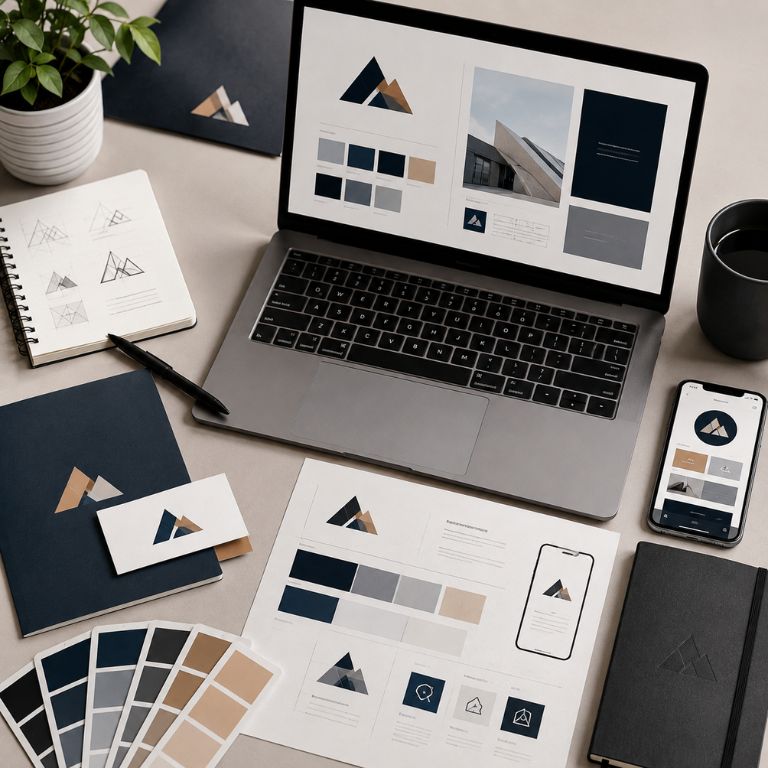
A strong brand identity is no longer just a logo and a color palette, it’s the entire system of visuals, voice, and experience that makes a business instantly recognizable across every screen it appears on. As AI-generated content floods every feed and attention spans keep shrinking, a clear, consistent digital brand identity has become one of the few real competitive advantages left. This guide breaks down what digital brand means in 2027, how to build one step by step, what it costs, and the trends actually worth following.
What Is Brand Identity?
Brand identity is the collection of visual, verbal, and experiential elements a business uses to express who it is: logo, color palette, typography, imagery style, tone of voice, and the way all of it feels across a website, app, packaging, and social media. It’s different from brand strategy (the positioning and messaging behind the brand) and different from a logo (which is just one visual asset). Design and brand identity work together strategy defines the “why,” and identity design turns that strategy into something people can see, hear, and remember.
A well-built digital brand identity does three things at once: it makes the business instantly recognizable, it builds trust before a single word is read, and it stays consistent whether someone finds the brand on a search result, a TikTok video, or a checkout page.
Why Brand Identity Matters More in 2027
Three shifts are pushing brand identity higher up the priority list for businesses of every size:
- AI-generated sameness – As more content, logos, and even websites get built with AI tools, generic design is easier to spot and easier to scroll past. A distinctive, well-designed identity is what separates a real brand from an AI-templated one.
- Multi-surface discovery – Customers meet brands through search engines, AI answer engines, short-form video, and marketplaces before ever visiting a homepage. A brand identity has to hold up at every size, from a tiny favicon to a full-screen video intro.
- Trust is now a design decision – With more AI-written content and deepfaked ads in circulation, a consistent, professional identity signals legitimacy the same way a business license used to.
How to Create a Brand Identity: A Step-by-Step Framework
Whether you’re building a brand identity in-house or briefing brand identity design services, the process generally follows the same core steps:
- Define your positioning first – Before any visuals, clarify who the brand serves, what problem it solves, and what makes it different from competitors. Skipping this step is the most common reason identities end up generic.
- Choose a color system, not just a palette – Modern identity design uses flexible color ranges that can shift by context (light/dark mode, seasonal campaigns, product lines) while staying recognizable, rather than one rigid set of hex codes.
- Select typography that works at every size – Test headline fonts at favicon size and body fonts on mobile because a brand identity is seen in a browser tab often as it is seen on a billboard.
- Design a flexible logo system – Build a primary logo and a simplified icon or monogram for app icons, social avatars and small placements where details can get lost.
- Write down your brand voice – Document how the brand sounds in a tagline, a support email, and a social caption, so tone stays consistent even across multiple writers or AI-assisted content tools.
- Build a living style guide – Instead of a static PDF, many brands now maintain a shared digital style guide (Figma, Notion, or a brand portal) that updates as the identity evolves.
- Test across real touchpoints – Preview the identity on an actual website header, a social post, a product mockup, and a small mobile screen before finalizing anything.
Brand Identity Design Trends Shaping 2027
Building on where design has moved through 2026, a few directions are carrying into 2027:
- Motion-first identity – Logos and icons are increasingly designed to move subtle animation on a website header or app splash screen and are becoming as standard as a static logo once was.
- Adaptive, flexible systems over rigid rules – Instead of utilizing a single, static logo and color scheme, firms are introducing identity systems that differ significantly based on the context or platform. Similar to Apple’s logo, which is essentially recognized, the surrounding system varies based on where it is used.
- Human texture alongside AI tools – As generative design tools speed up production, brands are intentionally adding hand-drawn touches, grain, and imperfect textures to signal a human hand behind the system.
- Sensory and multisensory branding – Sound logos, haptic feedback, and tactile packaging choices are being treated as part of the identity system, not an afterthought.
- Purpose and sustainability as design inputs – Ethical sourcing and environmental commitments are increasingly reflected directly in materials, packaging, and messaging, not just a separate “About” page.
What Does Brand Identity Design Cost in 2027?
Pricing for brand identity design services varies widely based on scope and provider type. Based on current market pricing, here’s a realistic breakdown:
| Provider Type | Typical Price Range | Best For |
| Freelancer (basic package) | $500 – $5,000 | Early-stage startups, simple logo + palette |
| Boutique design studio | $5,000 – $20,000 | Small businesses wanting a full visual system |
| Full-service branding agency | $11,000 – $70,000+ | Businesses adding strategy, messaging, and web design |
| Enterprise / rebrand program | $20,000 – $100,000+ | Established companies repositioning at scale |
The takeaway: a small business doesn’t need a six-figure identity system to look credible. A focused freelancer or boutique-studio package that covers a logo, color system, typography, and a basic style guide is usually enough to compete deeper strategy and multisensory extras can come later as the business grows.
Digital Brand Identity Checklist Before You Launch
- Logo works legibly at favicon size and on a large banner
- Color palette is documented with exact hex/RGB codes and accessible contrast ratios
- Typography is licensed for web and print use
- A written brand voice guide exists beyond “friendly and professional”
- Social avatars, cover images, and website assets are all updated to the new system
- Style guide is stored somewhere the whole team (and any freelancers) can access
- Identity has been previewed on mobile, not just desktop
Build a Brand Identity That Performs Online With Marketing Flavour
Ready to turn a strong visual identity into real business growth? Explore the full range of services at Marketing Flavour.
Looking for hands-on brand and marketing support closer to home? Explore our digital marketing services in Cincinnati for locally-focused execution.
Come across a term while researching brand strategy that you’d like explained plainly? Get a clear breakdown in What Is UBC in Digital Marketing?
Want to see the full range of services that support a brand from identity through to visibility? Browse our complete list of digital marketing services.
A strong identity needs consistent presence across every platform, check out our social media management services to keep your brand recognizable everywhere it shows up.
FAQs
What is a digital brand identity?
A digital brand identity is the set of visual and verbal elements of logo, color, typography, imagery, and tone of voice that a business uses to present itself consistently across websites, apps, and social platforms.
What’s the difference between brand identity and branding?
Branding is the broader strategy: positioning, messaging, and perception. Brand identity is the visual and verbal expression of that strategy: the logo, colors, typography, and voice people actually see and hear.
How do I create a brand identity on a small budget?
Start with positioning, then invest in a focused freelancer or boutique-studio package covering a logo, color palette, typography, and a basic style guide. Full brand strategy and multisensory extras can be added later.
How much do brand identity design services typically cost?
Freelancers generally charge $500–$5,000, boutique studios $5,000–$20,000, and full-service agencies $11,000–$70,000+, depending on scope and deliverables.
How often should a brand identity be updated?
Most businesses refresh visual elements like color, motion style, and photography every few years, while the core name and positioning stay stable far longer.
Do I need a brand style guide?
Yes. A style guide keeps the identity consistent across every designer, writer, and AI tool touching the brand, and prevents the “looks different everywhere” problem that undermines recognition.
References & Sources
- Fiverr. (2026). Brand Designer Cost: What to Expect in 2026.
- Tenet. (2026). Branding Package Pricing: How Much Does Branding Cost?
- Three Rooms. (2026). Brand Identity Trends 2026: 8 Shifts Defining the Future of Brands.
- The Branding Journal. (2026). Top Branding & Design Trends For 2026.
- SYNRGY Creative. (2026). What Does Branding Actually Cost? (2026 Breakdown).